
Advisory Process
The Practice Autonomy Directive — A 4-Phase Procedural Blueprint for Law Firm Founders
The Challenge
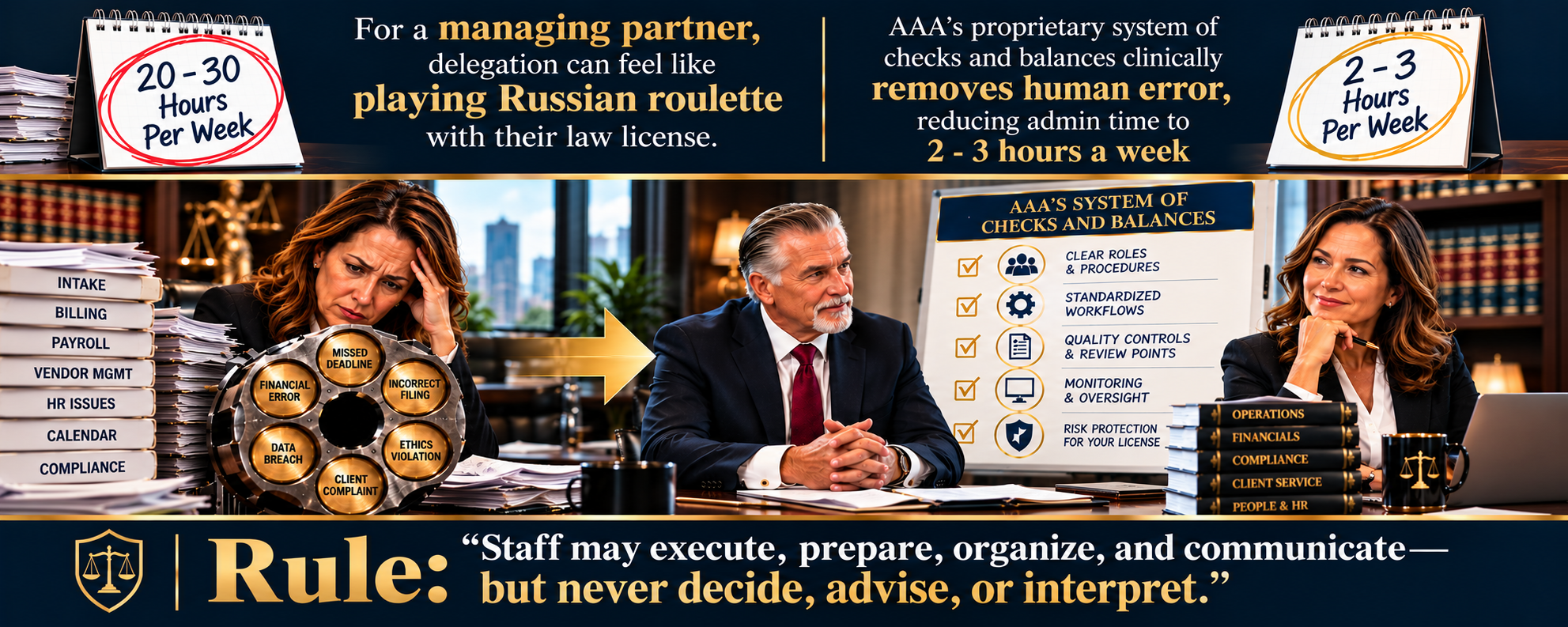
Most law firm founders do not own a scalable business; they own a highly demanding job. Out of a desire to protect their law license and maintain absolute quality control, founders routinely spend nights and weekends managing non-licensed administrative tasks. This structural bottleneck causes severe partner burnout, limits billable capacity, and restricts firm growth.
The Solution
Engineered by a seasoned infrastructure professional with three decades of strategic corporate experience followed by over ten years of specialized law firm advisory, this framework provides a rigorous, system-reliance protocol. Acted upon by a Principal Firm Strategist, it installs an automated operational firewall around your practice—permanently restoring your weekends and maximizing billable efficiency without compromising ethical oversight or quality control.
The 4-Phase System Protocol

The Operational Discovery
The Business Equivalent of a Deposition
A rigorous, 45-point diagnostic audit that uncovers exactly where your firm is losing billable hours, leaking cash flow, and exposing your license to administrative human error.
The Firm Infrastructure & Horizon Briefing
The Business Equivalent of Merit Hearing & Trial Exhibit
A 3-hour intensive session where we analyze the evidence of your firm’s architecture. We isolate The Hemorrhage (trapped operational cash) and map The Horizon (the blueprint for your firm’s autonomous future).
The 12-Month Autonomy Directive
The Business Equivalent of the Firm Mandate
Phase 3 builds an operational firewall to protect your law license as you scale your firm. It is a system of checks and balances that clinically removes human error. It is a system of absolute oversight that completely eliminates the need for lawyers to hold onto non-licensed tasks.
Scheduled Implementation Retainers
The Business Equivalent of a Settlement Framework
To protect your monthly cash flow and eliminate outside funding requirements, our active advisory implementation is structured as a predictable monthly retainer that aligns perfectly with your natural billing and cash-generation cycle.
Not Every Law Firm Needs a Comprehensive Operational Discovery
Sometimes the problem is already visible.

Firm Diagnostic
Is Growth Producing the Results You Expected?
- Is revenue increasing without a comparable improvement in profit?
- Does growth create more work for the founder?
- Are payroll and operating expenses increasing too quickly?
- Are attorneys performing work outside the agreed scope without corresponding fees?
- Is the firm investing in marketing without knowing the cost of acquiring a client?
- Are all practice areas contributing enough revenue and profit?
- Is the firm considering expansion without sufficient financial and operational evidence?
- Does the firm lack clear performance measures and accountability?
These conditions are rarely separate problems. They frequently indicate that the firm has outgrown its existing leadership structure, operating systems, financial controls, or method of making growth decisions.

Diagnostic Framework
Five Disciplines for More Profitable Growth
These five disciplines are diagnostic tools used to understand the firm. They are not separate consulting packages.
Mission Creep
Determine whether attorneys are performing work outside the agreed scope without corresponding fees—and whether those unrecorded services are quietly reducing margins.
Client Acquisition Cost
Identify the full cost of attracting, consulting with, and converting a new client so the firm can determine whether its marketing is producing profitable work.
Practice Matrix
Compare practice areas based on revenue, margin, attorney capacity, client demand, risk, strategic value, and future growth potential.
Practice Diagnostic
Examine leadership, intake, pricing, staffing, workflow, financial controls, client service, productivity, and accountability to identify what is restricting performance.
New Practice Area Launch
Evaluate demand, investment requirements, attorney capability, financial potential, operating capacity, and execution responsibility before committing resources to expansion.
When Relevant
Assessment Tools Used When Relevant
The following tools may be incorporated into an engagement when appropriate:
- Anonymous staff or partner surveys
- Financial and margin analysis
- Compensation assessment
- Client-acquisition-cost analysis
- Practice-area evaluation
- Marketing assessment
- Leadership and personnel assessment
- Workflow and operational review
- KPI and accountability review
Frequently Asked
Does the size of the firm matter?
The core operational liabilities are identical across firm size. Only the scale of impact has changed.
Begin the Conversation
Determine What Is Actually Limiting the Firm’s Growth
Growth problems are not always caused by insufficient revenue. The first responsibility is to determine what is restricting profitability, leadership capacity, execution, or long-term value before committing more time and money to expansion.
Request a Confidential Growth Conversation