
Speaking Engagements
Speaking
James Wittmack speaks to law-firm leaders, bar associations, estate-planning organizations, fiduciary groups, professional-advisor organizations, and legal conferences on the business disciplines that determine firm performance and the operational decisions that protect privately held businesses when a founder can no longer lead.
Presentation One
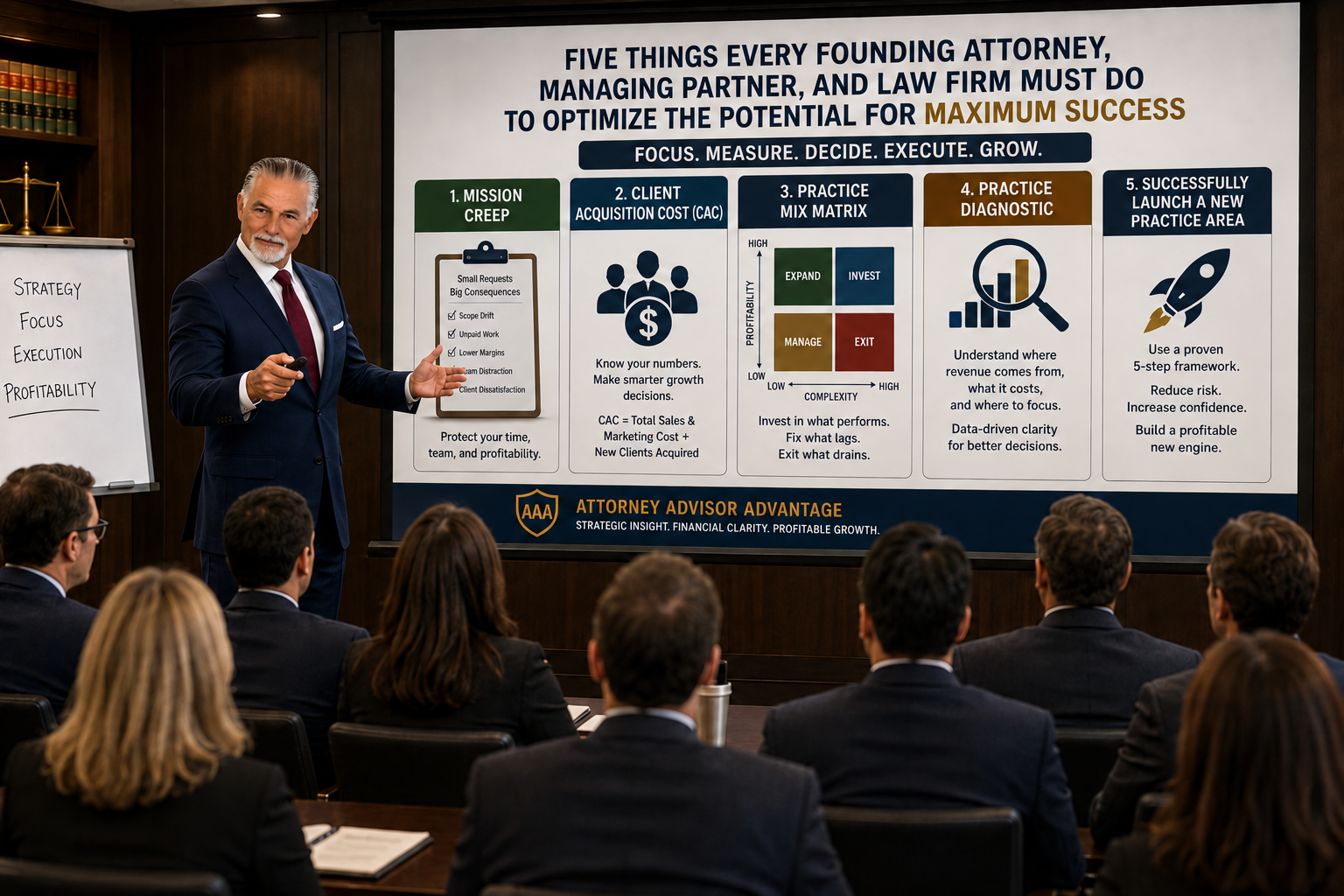
Five Things Every Founding Attorney, Managing Partner, and Law Firm Must Do to Optimize the Potential for Maximum Success
Successful law firms are not built through legal ability alone. They require disciplined decisions about client selection, pricing, profitability, practice-area growth, operational capacity, and execution.
In this practical presentation, James Wittmack introduces five business disciplines that enable law-firm leaders to recognize where growth, margin, and management problems may be developing before those problems become expensive.
This is not an abstract leadership presentation or a sales presentation. It gives attorneys a practical framework for examining how their firms make business decisions.
Intended Audience
- ▸Founding attorneys
- ▸Managing partners
- ▸Equity partners
- ▸Practice-group and department leaders
- ▸Law-firm executive committees
- ▸Attorneys preparing to establish or expand a firm
- ▸Bar associations and legal organizations
Business Issue Addressed
Many accomplished attorneys build successful practices without receiving formal training in business management. As the firm grows, unprofitable work, increasing client-acquisition costs, poorly evaluated practice areas, weak operating systems, and premature expansion can quietly restrict profitability and increase dependence on the founder.
Five Practical Takeaways
Attendees will learn how to:
- ▸Recognize and control mission creep before uncompensated work reduces profitability.
- ▸Calculate the actual cost of acquiring a new client and evaluate whether marketing is producing profitable matters.
- ▸Use a practice matrix to compare practice areas based on revenue, margin, capacity, risk, and strategic value.
- ▸Apply a practice diagnostic to identify weaknesses in leadership, intake, pricing, staffing, workflow, financial controls, and accountability.
- ▸Evaluate a new practice area before committing significant money, personnel, and leadership capacity.
Available Formats
This presentation may be suitable for consideration or submission for MCLE credit. Credit approval depends on the specific event and jurisdiction.
Discuss This Presentation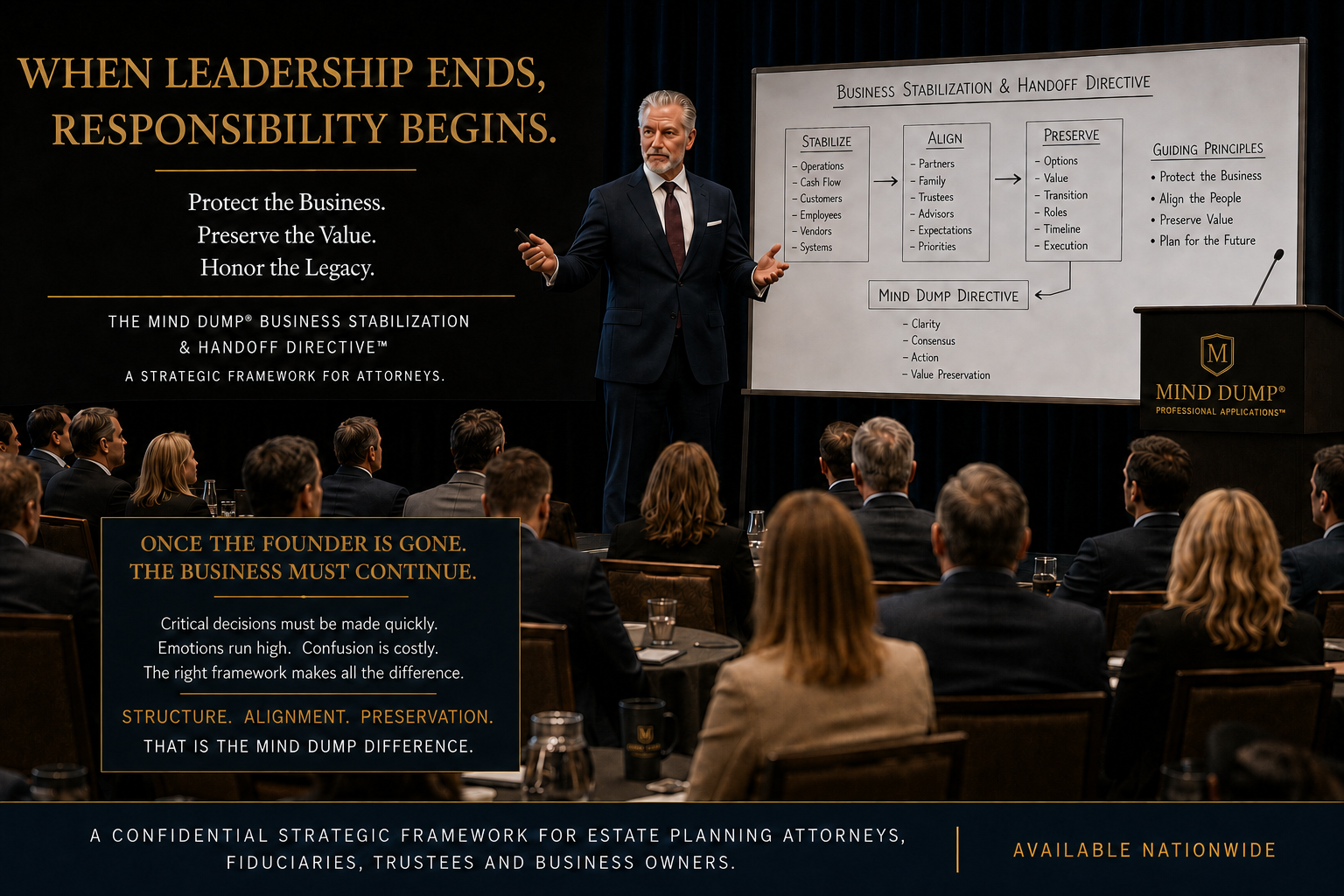
Presentation Two
When Leadership Ends, Responsibility Begins
Stabilizing a Privately Held Business Following the Death or Incapacity of Its Founder
When the founder of a privately held business dies or becomes incapacitated, the legal transfer of authority is only one part of the transition. The business continues to require decisions about employees, customers, cash flow, vendors, operations, banking authority, management responsibility, and communication.
James Wittmack introduces the Business Stabilization & Handoff Directive—a structured process for organizing immediate business priorities, aligning the responsible parties, and preserving enterprise value while attorneys and other professional advisors address their respective legal, fiduciary, tax, financial, and valuation responsibilities.
This framework is designed to complement the work of attorneys, fiduciaries, CPAs, valuation professionals, and wealth advisors. James does not provide legal, tax, investment, fiduciary, or business-valuation advice.
Intended Audience
- ▸Estate-planning attorneys
- ▸Trust and estate litigators
- ▸Professional fiduciaries
- ▸Corporate trustees
- ▸Family offices
- ▸CPAs
- ▸Wealth advisors and private bankers
- ▸Business-valuation professionals
- ▸Business owners and successors
- ▸Law-firm leaders
- ▸Estate-planning councils and fiduciary organizations
Business Issue Addressed
Estate plans and governing documents may determine who has legal authority, but they do not automatically provide the operational leadership required to keep a business functioning. Without an organized stabilization process, uncertainty can affect employees, customers, cash flow, vendor relationships, family members, management, and enterprise value.
Five Practical Takeaways
Attendees will learn how to:
- ▸Distinguish the legal transfer of authority from the immediate operational leadership a business requires.
- ▸Identify the critical decisions that must be addressed during the first days and weeks following a founder's death or incapacity.
- ▸Apply the three-part Stabilize, Align, and Preserve framework.
- ▸Coordinate family members, successors, fiduciaries, management, and professional advisors without interfering with their respective responsibilities.
- ▸Develop a written Business Stabilization & Handoff Directive that establishes priorities, responsibilities, risks, and recommended next steps.
Available Formats
Inquiries
Discuss a Presentation for Your Organization
Presentations may be adapted to the audience, available time, and objectives of the sponsoring organization without changing the central subject or professional scope.
To discuss an upcoming bar-association program, legal conference, professional meeting, law-firm retreat, or private advisor briefing, contact James Wittmack.